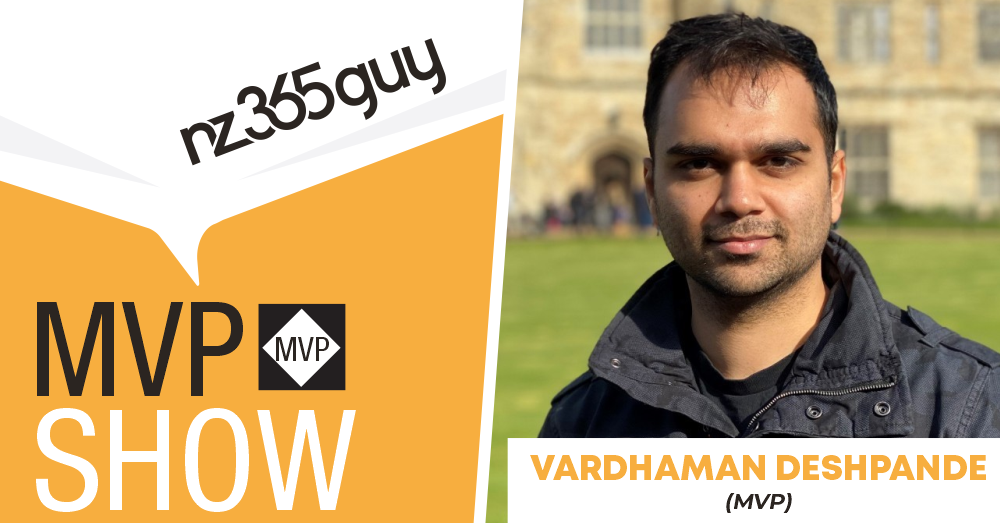
Pro-Code Agents Beat Low-Code: Here’s Why
Vardhaman Deshpande
Microsoft MVP







Pro-Code Agents Beat Low-Code: Here’s Why
Get featured on the show by leaving us a Voice Mail: https://bit.ly/MIPVM
This episode explores how AI coding agents are reshaping how software is built, through the practical experience of Vardhaman Deshpande. The core insight is that pro-code developers using natural language with modern AI models can now build features and agents faster than many low-code tools. The conversation examines velocity gains, trade-offs between pro-code and low-code, and what this shift means for professionals building AI-powered solutions.
🎙️ Full Show Notes
https://www.microsoftinnovationpodcast.com/809
👉 What you’ll learn
- When pro-code plus AI is faster than low-code tools
- How natural language is becoming a new interface for software development
- Where Copilot Studio fits, and where it may slow teams down
- How AI agents accelerate feature delivery and testing
- What skills matter as AI-driven development matures
- Pro‑code + AI agents are now outpacing low‑code tools for developers
- Natural language is replacing configuration as the primary interface
- AI’s biggest impact is velocity, both professionally and personally
✅ Highlights
- “My workflow is actually faster than doing something in a low-code, no-code environment.”
- “Pro-code plus AI coding agents might actually be faster to build than low-code.”
- “Recent models are amazing at translating natural language to code.”
- “Earlier something that took weeks I can probably do in a couple of days now.”
- “The velocity of creating features for products is going to explode.”
- “Why do you need that middleware?”
- “Prompting rather than configuring is the transition we’re starting to see.”
- “How much of pro-code versus low-code is realistic remains to be seen.”
- “Things which were prohibitively time-consuming have become possible now.”
🧰 Mentioned
- Microsoft Foundry: https://azure.microsoft.com/products/ai-foundry/
- Azure AI Services: https://ai.azure.com/explore/aiservices
- Copilot Studio: https://www.microsoft.com/microsoft-365-copilot/microsoft-copilot-studio/
- GitHub Copilot: https://github.com/features/copilot
- Power Virtual Agents: https://www.microsoft.com/microsoft-copilot/blog/copilot-studio/microsoft-power-virtual-agents-now-part-of-microsoft-copilot-studio/
- Microsoft MVP YouTube Series - How to Become a Microsoft MVP - https://www.youtube.com/playlist?list=PLzf0yupPbVkqdRJDPVE4PtTlm6quDhiu7
✅ Keywords
ai agents, pro-code, low-code, github copilot, copilot studio, microsoft foundry, azure ai, natural language coding, software velocity, ai development, microsoft ecosystem, automation
I’m Mark Smith - nz365guy - Helping people reach their full potential I have been a Microsoft Business Applications MVP for over 14 years.
I am passionate about helping people reach their full potential, through training, coaching and mentorship.
Accelerate your Microsoft career with the 90 Day Mentoring Challenge (https://www.90daymc.com/)
Support the show (https://www.buymeacoffee.com/nz365guy) If you want to get in touch with me, you can message me here on LinkedIn (https://www.linkedin.com/in/nz365guy).
Thanks for listening 🚀 - Mark Smith
00:03 - India’s AI Signal Is Loud and Clear
02:02 - Hunger Beats Hype: Why AI Adoption Is Exploding
04:21 - From Partner Roots to Independent AI Builder
06:21 - The Surprise: Pro‑Code + AI Is Faster Than Low‑Code
08:35 - Velocity Is the New Superpower
11:55 - Is Low‑Code Becoming Middleware?
15:40 - The Real Shift: From Configuration to Conversation
00:00:06 Mark Smith
Welcome to the MVP show. My intention is that you listen to the stories of these MVP guests and are inspired to become an MVP and bring value to the world through your skills. If you have not checked it out already, I do a YouTube series called How to Become an MVP. The link is in the show notes. With that, Let's get on with the show. Kia ora and welcome to the MVP Show. Today's guest is from India, Vadaman. Welcome to the show.
00:00:42 Vardhaman Deshpande
Great to be here. Thanks, Mark. Looking forward to having a chat with you.
00:00:47 Mark Smith
As are you, you know, you've been in the AI space a while and doing some great stuff. So I really want to unpack that. Before we do, tell me about food, family, and fun. Where are you located in India? What do you get up to? What was life for you?
00:01:00 Vardhaman Deshpande
So we moved back to India like just a couple of years ago. Before that, for about a decade or so, for 10 years I was in the UK. I've been doing consulting for a while now. So just in the AI space and Microsoft 365, Teams and everything else. But right now, living with India with my family, I have a young son. He's 5 years old now. He'll just be 5 next week, actually. So yeah, so we moved back to kind of live with the family and get some support and things like that. So yeah, and since I've been back, I've been kind of going into the local tech community, tech groups as well. getting to know what's happening here, getting to know different AI initiatives, also with Microsoft and independent of Microsoft as well. So yeah, I'm looking forward to having a chat with you about all of that today.
00:02:02 Mark Smith
It's very unusual for an Indian not to talk about food.
00:02:07 Vardhaman Deshpande
Exactly, You're.
00:02:08 Mark Smith
Usually very good in the food department.
00:02:10 Vardhaman Deshpande
Yes, definitely. So as expected, I think Indian food is my favorite food out of all the cuisines I would say, but I do like Mexican food probably the second most. I think they're closely related, Indian food and Mexican food, and then standard stuff after that, like pizza and stuff for the kids we order. So, but I think, The main thing being like Indian food is very, very like vast. You might, like, what you might get, like when I was in the UK, you might only get the food which is from like a certain part of India there. But now since I've been back, you can get a lot more variety. And that's been one of the main priorities since I guess I'm enjoying it here after coming back. So very, very happy about that.
00:03:07 Mark Smith
I'd love to hear your views on India at the moment from a tech perspective. You know, if you look at most of the global biggest companies in the world in tech, they're generally always led by Indian folk. You know, I'm ex-IBM, our CEO is Indian, CEO of Google, CEO of Microsoft, CEO of Adobe. Right. All, you know, so you guys know tech well, but tell me about the landscape now in India. You know, we're in early 2026. AI has been out now for, you know, about three years and it's changing a lot of things. We've seen, you know, the mandates in the US around visas and being able to do tech work, you know, and a lot of India folk that I know would be on those visas, whatever they are, I don't know the exact ones because I'm not American, but what's the feel of the tech landscape at the moment in India and the opportunity?
00:04:21 Vardhaman Deshpande
Yeah, I think with any kind of tech, I do see a lot of like people hungry, which means that any community event I go to, whether it's for students, whether it's for professionals, it's packed. If the capacity is something like 300 for the venue, there is like 1000 registrations. And then the organizers have to kind of pick the first 300 based on like who came first, who registered first. So I think just in terms of scale and population, right, just in terms of absolute numbers, there's a lot of interest in tech. Even before the AI wave came along a few years ago, anytime I used to kind of visit back, meet a few tech folks here, there's always like, there's always like a, I would say, an ambition or to kind of do something, whether it be startups, whether it be just like, AI from a Microsoft point of view. If I go to like a Microsoft event, there's students there wanting to know, like, you know, Amazon does this way. How does Microsoft do it? What will I, you know, so there's a lot of interest I see on the ground, and that's, I think... Two things. One is like the average age. I think India is like the one of the youngest countries right now. Like average age being something like, I'm not exactly sure on the number, but it's like the average Indian is something like in their 20s or 30s right now. So there's a lot of students. If there's a student-focused event I go to, there's a lot of questions we get. So if I'm presenting, after I'm done presenting my session, there's like 10 people coming up to me asking 10 questions each. So I just think that there's a lot of hunger and ambition as it has been before, even before the AI space. And sometimes when I go to entrepreneurship and startup focused events and community events, there is people coming up ad hoc and pitching their startups. So I remember I went to one event and a guy had created an AI app to create like bedtime stories for his kid. And he just asked, the organizer just asked like, you know, anyone ad hoc wants to present something like a demo. And he went on, quickly presented it, came back. There was another lady who had created like a recipes app based on AI. So you know, it was a great, great experience to go and see just the sheer number of activity happening, sheer events happening around. So I do see a lot of movement when it comes to tech in general. Now, how that translates into actual commercial stuff that is left to be seen, whether that person wants to go and work at a Microsoft or any of the Max 7, or do they want to continue their, create their own startup, they create their own, they want to be an entrepreneur. That's something left to be seen because you have to worry about like, you know, not only what you're passionate about, but also the like, you know, how do you pay the bills or how much runway have you got left. So that's also a very real concern. So it's always a case of balancing your passion versus reality, I would say.
00:08:05 Mark Smith
You mentioned Max Seven. What's Max Seven? I've not heard of that.
00:08:08 Vardhaman Deshpande
Oh, Magnificent Seven, like, you know, the Microsoft, Amazon, Google, the top seven tech companies, which we all know.
00:08:17 Mark Smith
What about, you know, below that, the Microsoft partner network, like community businesses, how big is that in your...
00:08:25 Vardhaman Deshpande
It's massive, it's massive. Like basically the reseller network. And not only that, and also like my first company was a Microsoft partner and ISV who used to do consulting for SharePoint for Teams on-prem SharePoint Cloud as well. That's basically how I got introduced to the Microsoft and Enterprise world. Because my very first internship slash job was in this space. I didn't do like, I'm an application, I'm from a app dev side of things, so I do solution development, like more recently doing like, you know, pro code agents and low code agents as well. But like my background is from an app builder point of view. So I got that start from a Microsoft partner. That's how I got. And then like, you know, there's a lot of folks doing that as well.
00:09:21 Mark Smith
Tell me about the work you're doing in AI.
00:09:23 Vardhaman Deshpande
So I'm an independent consultant right now. I'm building like pro-code agents mainly using what was like still there is Azure AI service, but now it's kind of folded into Microsoft Foundry. So I'm doing like, you know, Microsoft Foundry based agents. mainly to do with communication. Also on the sides, I'm doing the... So basically like building agents using Microsoft Foundry, a little bit of Copilot Studio as well to see like, you know, what the low-code slash no-code thing is. And I've been using like, you know, GitHub Copilot a lot for building AI agents or rather Pro code solutions, and there's a funny revelation I had is like, if I'm using GitHub Copilot and I'm using something like Cloud Opus 4.5 model, my workflow is actually faster than doing something in a low-code, no-code environment using Copilot Studio, so it's actually... I'm kind of getting a feeling like pro-code plus AI coding agents might actually be faster to build than low-code, no-code using Copilot Studio, for example. So maybe it's a very initial reaction or initial take, but let's see how it goes. Because I've been doing both, and sometimes, like, you know, building a flow or building a Copilot Studio agent, You have to do multiple iterations, but if you're talking naturally to, let's say, a.NET application or a TypeScript application, it's much faster. And the model, like the recent models, whether it be GPT 5.2 or Cloud Opus 4.5, they are like amazing when it comes to actually translating your natural language to code. So I've been like, you know, having a great time doing that. The velocity also increases. quite a lot. Like earlier, something like, I don't know, this is not an exaggeration, but earlier if you used to take me something like, few weeks to do, I can probably do that in a couple of days now. Whether it be like, writing unit tests, whether it is creating a feature, creating a UI feature, all of that I think has been sped up massively. So I think the velocity of creating features for products is going to explode now as more and more people start utilizing agents for creating solutions.
00:12:15 Mark Smith
It's interesting your take on Copilot Studio. I built my first chat agent, sorry, let's just call it chatbot, actually, in 2019 with Power Virtual Agents, which, of course, the modern-day name of Power Virtual Agents, as it iterated through, is Copilot Studio. And one thing that grabbed me early on when Microsoft started promoting Copilot Studio as heavily as it was, I felt they were trying to find a bridge for the low-code community into building agents And the middleware to do that is Copilot Studio. And I've always thought, why do you need that bit of middleware in it?And I'm not a developer, but I have definitely, let's say, played with GitHub Copilot in VS Code, things like that. And I'm like, Why do you need that middleware? Because in the pre-natural language, you know, instruction that you can give to AI, low-code app development was a big deal because it opened up the audience that could, they could configure apps, right? They could build out workflows through a picker and, you know, put a little bit of, a little, you know, front-end scripting and stuff like that, they didn't have to be a pro developer and they could get a certain way, but I've always felt that the configuration journey had a lot of overhead with it, a lot of time overhead to still do it, even though you could have perhaps a lower technically skilled, you know, non-developer do that type of work. Now with the coding language as natural language, and it will do it, you're the first person that's kind of helped me... I feel like you're supporting my argument that I've been saying, that you're like, Mm, I can pretty much do it quicker. And this is a little pivot I've also noticed from Microsoft in their conversations recently, is this whole using... as in, yeah, prompting in whatever you want into the application rather than configuring what you want into the application. I'm wondering if that's the transition that we're going to see, because I've always felt people that were like heavily, you know, What's your core skill now? Like Power Virtual Agents, you know, is my thing, or Power BI, or... Power Pages. And I'm wondering if those deep skill sets are going to disappear over actually being able to code with AI directly without needing all that baggage for every scenario when it comes to configuring.
00:15:39 Vardhaman Deshpande
It remains to be seen, where does that dial or where does that knob kind of end, like how difficult it would be to basically not use any of those low-code tools that just build yourself. Maybe even then there will be this need of some kind of middleware or framework which allows, like, you know, someone who hasn't done code at all or who doesn't want to do code to use the benefits of code. And maybe there has to be some kind of framework or something in there. So I think it's like we've got a great future ahead of us, I think, with it's a mystery, like it remains to be seen, but in terms of like, let's say if I get a requirement for an app which does, let's say, five things, and then if I can basically... standardize those five things into a natural language. And I know that a little bit coming from a technical background, okay, I need to host this in Azure. I need to use TypeScript for the front end.I need to build this a few APIs. If I'm able to explain all of that to like a GitHub Copilot agent, it will go ahead and build that in like, I would say in not in fraction of a time, but much lesser than the same thing which I would be doing with like low code and no code tools. So I think that's a reality right now, at least coming from a developer background for me. But completely going away with, let's say, Power Pages or Copilot Studio or Power Automate, I think that's kind of just remains to be seen. Like, where does that knob or dial take us to? How much of pro-code versus low-code is realistic, I think, at the end of the day. It's a great time to find out.
00:17:39 Mark Smith
As we go to wrap up, tell me about how you're personally using AI in your life. So forget business and what you do. Like, how do you, give me some examples of how you've been using it over the last year or two?
00:17:52 Vardhaman Deshpande
So I think I have been using ChatGPT quite a lot for personal projects and personal things. I think just doing research. I used to use the research capabilities of ChatGPT quite a lot before, not so much now. So things like, doing a research on different investments, for example, if I have to make, how does this compare with this, like, different ETFs, for example. But leaving aside that, like just a fun example. So my son is just starting reading in school now. So they gave him like a very simple book, which has like 4 pages of four animals, and he has to read what is written for each animal. So he did the four pages and now what to do next. So I took pictures of those four pages, uploaded it to ChatGPT and asked it to give me four more animals and the text for even more animals like that. So based on that book, I was able to create like a new book which had new animals and new content, exactly the same format. All the similar words who would be easy for someone to read.And so just extended that time. So that's another fun example. Like my wife, for example, is using like the image creation to create labels for some products which she's working on. So there's a lot. Like earlier, I think the bottom line is that earlier, these things were possible, but it might have taken weeks or months to do those. But now you can do those with a simple prompt. I think, and the velocity and the speed at which you can churn out stuff, I think has increased quite a lot. So that speed, I think, is the main benefit here. Things which were like, prohibitively taking a long amount of time have become possible now. Like I would never have created a new book myself based on what was in my son's book, but it's possible now. really, really enjoying the personal side of AI as well.
00:20:06 Mark Smith
I love it. Vanderman, thank you so much for coming on the show.
00:20:10 Vardhaman Deshpande
Sure, thank you. I had a great time and thank you so much for inviting me.
00:20:19 Mark Smith
Hey, thanks for listening. I'm your host, Business Application MVP, Mark Smith, otherwise known as the nz365guy. If you like the show and want to be a supporter, Check out buymeacoffee.com/nz365guy. Thanks again and see you next time.

Vardhaman Deshpande is a Microsoft 365 & Azure solution architect and Agentic AI consultant working with enterprise customers globally. With over 15 years of experience on the Microsoft cloud, he designs and builds production-ready agents.
A Microsoft MVP for the past eight years, Vardhaman combines deep technical expertise with strong business stakeholder engagement, shaping use cases, governing data and security, and measuring value.