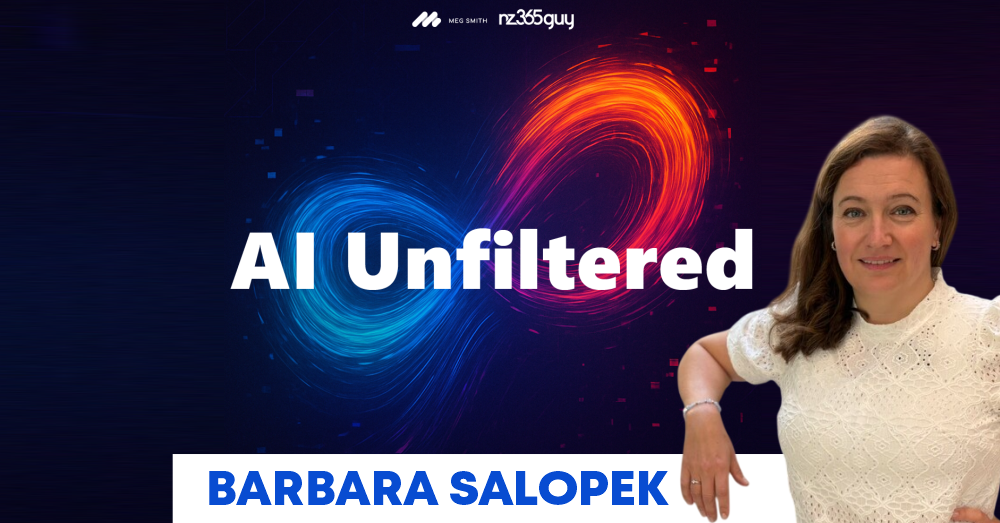
Why AI Alone Won’t Fix Innovation Culture
Barbara Salopek







Why AI Alone Won’t Fix Innovation Culture
Get featured on the show by leaving us a Voice Mail: https://bit.ly/MIPVM
👉 Full Show Notes
https://www.microsoftinnovationpodcast.com/829
This episode explores why AI and innovation fail without culture change. Drawing on decades of innovation experience, the discussion breaks down common myths around productivity, frameworks, and lone heroes. The core insight is simple but hard to execute. Sustainable AI adoption starts with leadership alignment, psychological safety, and recognising that everyone is creative. Real change happens bottom‑up, reinforced by long‑term discipline, not hype or short‑term fixes.
🎙️ What you’ll learn
- Why AI does not automatically improve productivity or innovation
- How leadership behaviour shapes innovation culture
- What psychological safety enables in teams and organisations
- Why every employee is creative in practical, everyday ways
- How to build long‑term innovation habits that actually stick
✅ Highlights
- “If it’s that easy, everyone will be doing it.”
- “Sometimes I think AI makes me more unproductive.”
- “There is no lone hero that is going to save the company.”
- “Everyone knows at least one thing how they can improve something.”
- “Innovation is much more complex than one framework.”
- “Psychological safety is a property of a group, not an organisation.”
- “Everyone is creative, not just artistic people.”
- “Changing behaviour is one of the most difficult things.”
- “You cannot trick people, they will see if you walk the talk.”
🧰 Mentioned
- AI adoption: https://learn.microsoft.com/azure/cloud-adoption-framework/ai/
- Innovation frameworks: https://www.deloittedigital.com/us/en/offerings/customer-led-marketing/customer-strategy-and-applied-design/applied-design-and-innovation/ten-types.html
- Design thinking: https://online.hbs.edu/blog/post/what-is-design-thinking
- Business Model Canvas: https://www.strategyzer.com/library/the-business-model-canvas
✅Keywords
ai adoption, innovation culture, psychological safety, creativity at work, leadership, organisational change, productivity myths, design thinking, innovation frameworks, applied ai, business innovation, technology change
Microsoft 365 Copilot Adoption is a Microsoft Press book for leaders and consultants. It shows how to identify high-value use cases, set guardrails, enable champions, and measure impact, so Copilot sticks. Practical frameworks, checklists, and metrics you can use this month. Get the book: https://bit.ly/CopilotAdoption
I’m Mark Smith - nz365guy - Helping people reach their full potential
I have been a Microsoft Business Applications MVP for over 14 years. I am passionate about helping people reach their full potential, through training, coaching and mentorship.
Accelerate your Microsoft career with the 90 Day Mentoring Challenge (https://www.90daymc.com/)
Support the show
If you want to get in touch with me, you can message me here on LinkedIn (https://www.linkedin.com/in/nz365guy).
Thanks for listening 🚀 - Mark Smith
06:15 - AI Will Not Fix a Broken Innovation Culture
08:40 - The Lone Hero Trap: Why Innovation Cannot Be Outsourced
09:05 - Productivity Hype vs Reality: When AI Makes You Less Effective
11:05 - Innovation Starts With People, Not Frameworks
20:30 - Behaviour Change Is a Marathon, Not a Launch Event
23:20 - Psychological Safety Is the Real Innovation Engine
25:04 - You Are Creative You Were Just Taught the Wrong Definition
00:00:07 Mark Smith
Welcome to AI Unfiltered, the show that cuts through the hype and brings you the authentic side of artificial intelligence. I'm your host, Mark Smith, and in each episode, I sit down one-on-one with AI innovators and industry leaders from around the world. Together, we explore real-world AI applications, share practical insights, and discuss how businesses are implementing responsible, ethical, and trustworthy AI. Let's dive into the conversation and see how AI can transform your business today. Welcome back to the AI Unfiltered show. Today I'm joined by Barbara, who's joining me all the way from Norway, beautiful city. I've been there a few times. Barbara, welcome to the show.
00:00:54 Barbara Salopek
Hi, Mark. It's a pleasure to be here. Thank you for inviting me.
00:00:58 Mark Smith
I think I said Norway is a beautiful city. I think it's more like a beautiful country.
00:01:02 Barbara Salopek
Yes. But I think the New Zealand is the same. I think they are a little bit similar in the geography.
00:01:07 Mark Smith
Lots of fjords and wonderfulness.
00:01:09 Barbara Salopek
And the good wine. And you know, I'm originally from Croatia and I know there are many Croatians in New Zealand making good wine. So.
00:01:16 Mark Smith
Yeah. My wife and I went and lived in Croatia for a month.
00:01:19 Barbara Salopek
Oh, really? Yeah. That was more like feria. Like holidays.
00:01:24 Mark Smith
it was a holiday. As in, we were traveling for 18 months around the world. And we had done lots of traveling where we would do three days in a location or a city. And we were just like, after a year, we're like, we want to take one month just to, in one place and stay. And so we stayed in Dubrovnik for a month.
00:01:44 Barbara Salopek
That's the most beautiful.
00:01:45 Mark Smith
And then, but we did day trips then, like into Mostar and all over the place. And It was in the off-season, the middle of the off-season. So mid-November to mid-December.
00:01:58 Barbara Salopek
Yeah, it's perfect. A little bit winter, a little bit windy, but it was no tourists.
00:02:03 Mark Smith
Yeah, and so that meant every wine bar, we could go in, spend time with the staff, really take our time and enjoy it.
00:02:11 Barbara Salopek
Nice prices.
00:02:14 Mark Smith
It was great. It was perfect. No cruise ships were there or anything like that. It was just Absolutely fantastic. And the person whose place we stayed in, he then chauffeured us all around and wherever we wanted to go on day trips, he would take us and just, yeah. And of course, in New Zealand, many of our vineyards in New Zealand were established by Croatians.
00:02:38 Barbara Salopek
Yeah, I know that.
00:02:40 Mark Smith
Yeah. In fact, I have a bottle of port that was put down the year I was born. So that means it's 53 years old. And it was a Croatian port. So like that's how long the industry has been in New Zealand, run by Croatians. And then there's a vineyard just down my road, which is still owned. Well, it's still semi-owned by Croatians, but it was like invested in by Chinese. But it's still run by Croatians. Like last name like Jovic, I think. Jovic, yeah. And And interesting, I know this is not out of podcast, but interestingly, the wine, which was a white wine, it's called White Diamond, and we used to pay, let's say $29 a bottle, right? After the Chinese purchased it, went up to $600 a bottle.
00:03:34 Barbara Salopek
$600?
00:03:35 Mark Smith
Yeah, they loved it so much, they just bought everything. $600 a bottle.
00:03:40 Barbara Salopek
That's like 300 times increase in price, is it?
00:03:43 Mark Smith
It was, it's a very sweet wine and it seemed that the Chinese market just loved it. And so, yeah. But because we were local, you could still, we could get special rates closer to the $29. That's nice. Yeah, It was very good. All the ones that didn't get exported. Anyhow, tell me about food, family, and fun.
00:04:06 Barbara Salopek
Okay. Well, I love this question. And now, you know, it's Easter holidays here in Norway, so I'm doing some bread baking with my kids. And they're all home and just experimenting with different recipes for the bread. And we all love to kind of good food. And something that connects us all is dinner and then, you know, trying new things. And And then when, and the most fun is when we try some new recipe and everyone is happy around the table and everyone's like, my God, this is so good. my God. And it's like bubbles of happiness, So that's something that we love. And yeah, and I was with my son in Oslo for two weeks ago and then we were also trying some good food there.
00:04:50 Mark Smith
Do you know? Surprising to say some of my best sushi that I've ever had is in Oslo.
00:04:56 Barbara Salopek
Yeah, but the interesting thing about sushi is the salmon on sushi is invented by Norwegians.
00:05:02 Mark Smith
Wow.
00:05:02 Barbara Salopek
You didn't know that? Yeah. They brought it to Japan in 60s or something like that. And one of my former colleagues that worked, I think he was in delegation with that project a long time ago.
00:05:16 Mark Smith
Wow. The reason I was there as a, I've been a couple of times, but one of the times was to speak at a Microsoft event in Oslo. And then we had a friend that my wife worked at Google for 10 years and one of her friends in Google Australia transferred to Oslo, Google Oslo. And so we'd go and visit her when we're living in London. And so that was.
00:05:40 Barbara Salopek
Nice. You have been living all over the world or traveling the whole world.
00:05:45 Mark Smith
Yeah,
00:05:46 Mark Smith
I'm pleased to be home in New Zealand though now. First of all, you've written a book and it's caught my attention because one thing I've noticed over the last two years, three years as AI has ballooned around the world is there's two common narratives that come out around AI in the corporate environment. One is it's going to make everybody hyper-productive and productivity is all that we want. And it's funny because I've heard people go, I'm really productive already.
00:06:15 Mark Smith
I just need some more time back so I can get home and see my kids at a reasonable hour rather than working ridiculous hours. So don't tell me I need to be more productive. And then on the innovation side, an interesting thing has come out. And my wife and I wrote a book on AI adoption last year. And one of the interesting things that came out in our research is that People can't just turn on innovation if innovation and culture has never been in the business. If people have been stifled, we cannot just, let's start innovating because we've got this AI tool. People have muscle memory of their organization. And so that's why your book caught my attention. So tell me a bit about your book. What's it about and what are you addressing in it?
00:07:06 Barbara Salopek
I love your introduction because you really captured the main of the book, and that was also my motivation to write it because, I have been working now with innovation for more than 20 years in different types of roles. And as you say, like people suddenly think that a new framework comes. Now we're all going to be innovative. Like this framework is going to save all our problems and everything pains. And then business model canvas comes, design thinking comes, and then after a year, we are still almost at the same position we were a year ago. And I was thinking, like, if it's that easy, everyone will be doing it. And now, then, different things come as a fashion, and now we have IE. And suddenly, everyone is going to be productive. And I can answer this also from my personal perspective, as I use IE very much. Sometimes I think it makes me more unproductive as well. Like I put the prompt in, can you do this? And then it comes with so much suggestions, this, and this. And I was like, this is too much. I didn't need that much. I just need a small answer. And then I can do this for you. I can do this for you. And I can do it. And I'm a very curious person. Okay, let me see this. Let me see this. And then I was like, I didn't need all that. So it's very, things come in fashion, in waves, and we love to embrace them. I think they're going to save the world, but at the end, they are not going to do that. And I also write in the book about the lone hero trap. When we believe one person is going to save us, you know, the Hollywood movies, here is the hero, and he is going to save the whole company, and everyone is going to be innovative, and everyone is going to be I. And they're like, no. So that was my motivation to write the book and explain things a little bit more complex, and we live in a little bit more complex world than just one framework. So I was, researching a lot for each chapter. I read more than 60, almost 100 articles, and tried to kind of compose what I think was important. And Organizations are made by people, by individuals, and individuals make groups and groups make organizations. So that's the kind of framework or the context of my book. And in each of those levels, the individual is in the center. And they're the ones who are either using or not using, are afraid or not afraid of new technologies, of innovation. We have all our own personalities. We have all our rigidness. Someone are much more open. Someone is less open. We all have different contexts. And this influences the groups we are shaping, how we act in the group, who we as a leader are leading the group or motivating the group, how to behave. And then those groups, and I use group intentionally, not the team. Why? Because you have formal and unformal groups. And teams are always formal. And I wanted to embrace also informal parts in that sense. And then we have organizations. And organizations are today so much exposed to so many demands from environment, from context, from regulators. And one of the biggest 2 shapers of the organizations are sustainability demands and technology advancements. So that's the last, that's what I'm focusing on, how those are impacting the individuals in the company. And this also includes leaders, of course, because leaders are making decisions. And then in the book, I'm talking about that when you are When you're introducing something, in this case, I'm talking about innovation, but it can apply for IE, technological advancement whatsoever. You need to have the top leaders understanding what they are going into. They really need to understand that this is not a one-time framework, because if it is, everyone will be doing it and we wouldn't be standing here and talking about this subject. But they need to understand that it takes the top leadership alignment, right, and strength to pursue, but then It, as I said, the lone hero trap. There is no lone hero. It has to be built bottom up from everyone because everyone has and know how to, knows at least one thing how they can improve something in a company. And everyone has to build it together because you have 1,000 people company and two people are not going to save the innovation. or one small team of five people for 1,000, you need everyone going in the same direction. And they are going, if you have top leadership, who knows how to roll it down to the middle management, and then they all understand their roles and in order to bring it up. Did I answer the question? It went.
00:11:51 Mark Smith
So what I find interesting out of that is that my really big takeaway was everybody has something to bring to know how to improve the business, which Totally, I've seen that. What happens if you have your historic culture of the organization has not to be innovative or not encourage innovation? And I'll give you an example that's personal to me. I resigned from my corporate career about a year and a half ago, maybe a year ago. And the corporate I was working for was IBM. And I was brought in to set up a practice in Australia around low-code software development. And I quickly learned that there was no desire to innovate. There was no desire to do something new. There was no framework for it. There was no encouragement of it anywhere in the organization whatsoever. Because I really had a deep sense that us at the bottom of the world, all ideas came from New York, the head office, and you just need to implement what we tell you is right. And so this innovation was just, literally crushed inside the organization, which is crazy because IBM had a reputation over its 114 years, I think at that point, of being massively innovative, but also presented with massive opportunity that has dropped the ball on time and time again. So how do you now, like, and I'm seeing so many companies like this, they now say we want to innovate. We need to. Now, AI is going to change everything. They're fearful. They're fearful that their competition's going to take them out or that a new startup's going to come along and take their business. Their historic moat of invincibility, this new technology is just leveling the field for everybody. But how do you kickstart a culture of innovation when you could be at that other end of the pendulum, you've stifled it? Or you've just have had no framework of encouragement of innovation inside the organization. And now you're saying, hey, we need to innovate or change. And people go, this is just the latest fad that management are after.
00:14:09 Barbara Salopek
Yes. So lots of beautiful insights here, what you're saying. And I want to reflect, you're absolutely right in your statements. So I see when you talk about innovation, it reminds me, everyone talks about innovation, but actually they're not doing it, right? And it's similar to greenwashing in sustainability. This is all water, right? And everyone is doing innovation, whatever you do, which is also diluting the value of the term. Like you make a new web page, now we are innovative, like we are innovative consultancy doing the web pages, just doing the new designs. which is true in a way, but, and IBM is interesting case because they have, as I'm teaching as well, and I use always IBM as an example, how many patents they do, they have around 300,000 employees. if I remember good. And the time that the tables I had, I think they patent 9,000 patents per year, approximately.
00:15:12 Mark Smith
They used to be the largest patent creators, but that stopped about four years ago. They used to any more than any other company, but that's going down. Yeah.
00:15:20 Barbara Salopek
Yes, because I compare it to Norway who has 5 million, 5 million inhabitants and And I think approximately same number of employees working for us, and they are kind of patenting 2000 per year in Norway, but maybe they're doing it abroad. So I'm always saying like, patenting is one of the things that they usually is metrics, how innovative you are. That's usually used. But as you have pointed out, it's very centric in the company you mentioned. And so There are certain barriers when we talk about innovation, and there is psychological barriers, like people losing control, cognitive rigidity. Not everyone, and like I'm a very open person, and I like to test everything, but as I'm teaching now, they're introducing a new software for something, and I just don't have time for it right now. But I'm very open. So there are different things that influence why we test something or why don't. Something like cognitive rigidity, we are stuck in the old ways, intolerance for the new things, preference for stability, habitual resistance. So they're all different things on individual levels. And then also you have organizational, on organizational level, also psychological things like perceived risks, attachment to the familiar, to like the old ones, rigid corporate structure or organizational barriers, short-term thinking versus long-term. And if you are a US company, then it's very short-term. These quarters, everything is in quarters. Nothing is in 10 years' time. So visibly. And both innovation and sustability, they demand long-term perspectives because innovation, we saw that it doesn't, design thinking doesn't fix it by itself. A business model canvas, whatever you implement, it doesn't fix it by itself. We have to have like 10 years perspective. And not everyone has that. we all are, we all like getting money today, not in 10 years time. So yes, but that's also human, that's also human, right? So we cannot, and all those humans, they're shaping the top leaders, you know, as we have the humans down with the same portfolio we have on the top, more or less. And then we have this upper echelons theory, which says that The top leaders, they're shaping how the things are like. Their characteristics are shaping how they are making decisions. So it's all connected. And that's why I, and they said, what should companies do? And that's exactly the book. The aim is for the leaders, for them to understand. It's much more complex. You cannot just have a quick fix. No one has a magic stick and now, like now you are. So if someone wants to do it, really has to understand the depth. And when you have leaders who understand the depth that it's not greenwashing or innovation washing, we can want to make it, but they really want to make it long term. And some companies did that, like Procter and Gamble. You have some companies here in Norway that I'm mentioning in the book. So some are doing it, but mostly, you know, as I said, for the reason that I mentioned, it's complex and innovation is a very abstract term.
00:18:36 Mark Smith
So For those companies that you've mentioned that have done it, have gone on the journey, was it a group of people that had the wherewithal in the organization to decide to take that direction? Or was it an individual, like a CEO or something that had a vision and really charted the course? What did you see that mix that sparked that long-term change?
00:19:01 Barbara Salopek
It has to come from the top, absolutely. And the parent bank in Norge, that I'm mentioning in the Norwegian Saving Bank, that I'm mentioning in the book as a case, because they were small regional banks and they use technology, they use IE to make them a modern bank and they are growing to the national bank and from small Bergen city. And it's from the top, from the CEO, and then making his team to understand this is what we're going to do and like making this as a religion. Like this is what we're going to do and everyone has to be on board. They had to change. They had to change the culture. They had to stop thinking in silos. We, like in the departments, we against them. They have to have to think like one in the same direction. And they have been doing it for a long time. And they have been doing it quite successfully. They have really grown and the value has growing and the value that they have been giving back to the society has been growing over the, I would say maybe 10 years since they have been doing it. Yeah.
00:20:02 Mark Smith
And so when you have that vision, is management almost implementing like a project? Because this is not a, we announce it and then there's nothing for weeks or months or then, oh, there's a little update. I assume there's some new rhythms that have to be embedded into an organization. and signals that people go, this is the way we do it now, rather than that was the way we did it.
00:20:30 Barbara Salopek
I think it's a long marathon to take and you have to have all, every now and then you have to have those reminders on which path we are. And because changing behavior is one of the most difficult thing. You know, we all have patterns how we behave. if you are running five times a week and once you stop and this becomes your habit, it's very difficult to start again. But if you've been running for three days this week and last week, five days and previous five weeks, then it's so natural for you to, okay, today's Thursday, I'm running at 5. You're just doing it naturally. So I think changing, like try running on the athletic field in the different direction that you usually do, it's going to be crazy. It's going to be crazy. Like, oh no, this is so unnatural. This is so un. unnatural, and then you actually, the brain fights against it. So I think you cannot think like, okay, now we are going to hire an expert for a week or for two days, three days, but you have to have all, like, every now and then, because it's like with the diets, right? You have this motivation, up, yeah, we are going to do it, and after two days, no, not today. I slept well. Maybe I will take a chocolate today. And it's everything happens. Everything escalates also like in a people in organizations because there are people at the end. So everything will multiply is there. And motivation, I like in one book I read the motivational monkeys. You know, now you see them, now you don't. So you have to have the discipline, long-term discipline. And then you have to have someone to help you sustain this long-term discipline. Until this discipline becomes a habit. And when it's a habit, then you don't have a problem anymore.
00:22:08 Mark Smith
What have you seen that helps unlock the 1000 employees that have inherently just been following the system that's been in place? How do you create that unlock where, as you said at the start, everybody has an idea on how to improve the business? They've just not been listened to or... they might have been listened to, but obviously by actions never responded or nobody's ever done anything. How do you start generating that kind of flywheel, that interest, that motivation to contribute again after it's perhaps never been a part of the culture of an organization?
00:22:46 Barbara Salopek
Beautiful. Yes. And that's, I talk about, they're a simple thing. You have, as a leader, Psychological safety is a property not of an organization, but of a group. So what kind of theme or atmosphere says the leader, it's going to be in the group. And it can be different packets of psychological safety in the same company, high or low. So that means the leaders, actually the middle management is extremely important. So they have to understand what's their role, right? They really have to understand that they're shaping the psychology of safety, how they're shaping it, and in which direction they should be shaping it, right? And there is another one thing that I'm mentioning in the first part, that's the first part of the book has two chapters. One is creativity and one is psychological safety. And for the leaders, they also have to understand that everyone is creative. And what does this creativity means, right? And when you say, And usually you have this big conference, annual conference of the big company, 500 people are there, and they pay someone to come and talk and say, and after that, everyone is going to be creative. Everyone is coming to read ideas. And then after the night is over, everyone forgets what happened, right?
00:24:06 Mark Smith
I've been there.
00:24:07 Barbara Salopek
Everyone has been there. Like it's really strange if you haven't, right? And then And actually, when you tell, Now, Mark, now you think out-of-the-box, and you're like, Oh my God, not me, not me, please, not me. I slept bad tonight. I cannot think. I'm like, people get also scared and it's a stress. Will I perform how my manager is this? Like, so that all those things are shaping how people are... how they're meeting the demand that they have to contribute, think outside the box and be creative. And in the book, in my creativity chapter, I explain that we have different types of creativity. One type of creativity is artistic. And we all think, you know, oh, not me, I'm not, because I think I cannot draw, I cannot sing, I can play piano, I'm not creative. And that's artistic. And we all think those two are synonyms. They're not. It's just one part of it. And then we have scientific creativity, which is wonderful. It says like all the researchers, all scientific things that are coming. And the definition of scientific creativity is that you need to have a deep knowledge of something to combine those knowledge in new ways. But actually, I think that's the pure definition of creativity itself. Any type of creativity. Of course, you always can have with the new insights if you're coming from outside, that's always going to happen. But in order to make things in a new way, You have to have some deep knowledge about it, right? When you open the fridge and what I'm going to cook today, you have the deep knowledge, what goes together, how the things are cooked, what you can do with eggs, right? You have deep knowledge, so you can combine this and make something out, even though you don't have a recipe. So we have everyday creativity, which is based on everyday deep knowledge about small things, how people like solving some small problems. That's creativity as well. And then back to your question, how each employee They all have deep knowledge about the thing they do, right? So they know how to combine this knowledge and make new ones. And then if the leader, but if the leader is not aware that this is how creativity is, then they cannot help them to be more creative because it will, she or he will think you like creativity equals artistic. And then the people also will think that.But if the leader knows, no, creativity is having a deep knowledge. And then if you combine diversity in that, because you can look through different glasses, you have different experiences, different backgrounds, different education. And then you can look at it from different perspectives, which brings unique angles to the things. So you have double, you double the potential of your creativity. So, but at the end, again, leaders, managers, they need to understand those things so they can implement it on the levels.
00:26:58 Mark Smith
Yeah. Something simple that you said then was everybody's creative. And it's such a simple statement, but I think there's many people that don't believe they are creative.
00:27:13 Barbara Salopek
Yeah, I was the one. I was not, I have a mother and a sister, they are designers, they are artistic. I'm not. And I always thought I'm not creative, but we all are. We all, there is no month that you haven't come up with something new at home.
00:27:29 Mark Smith
Yeah. When I first was exposed to design thinking, maybe 15 years ago, And I watched this, I was in a company that had a whole design thinking arm and it was amazing. And these guys were incredibly creative. And I always thought with the word design in it that you needed to be a designer to be in that team. Now, since then, inside Microsoft, I've taken over 2,000 people through design thinking sessions that these are employees of Microsoft. And I can still clearly remember thinking I could never do this because I was not creative. And I wasn't a designer. And definitely, I feel like the generation I was brought up when, there's a big emphasis on left brain and right brain thinking, and you're either analytical or you're a creative, but you could never be both. And I'm just like, that is such rubbish because, you know, I have become, I feel, the older I've got, the more creative I've become. Because I've given myself permission to be creative rather than what society said it was.
00:28:32 Barbara Salopek
And that's a wonderful enlightenment you got, you know, and imagine that if every employee got this enlightenment and understands that it's not about, you know, and even the biggest pianists, the painters, they have to do tons of things. And in the book, Creative Confidence, there is this research made, and the people who made the most pots were most creative, not the ones that were creative and made less. So again, you have to deep knowledge, you have to exercise in the field so you can make it better. And we forget this part.
00:29:06 Mark Smith
Yeah. You know, that's the other thing that you've said that's really resonated with me is that everybody in their role inside an organization has their deep knowledge of their role. And out of that, The beauty is they know where to apply the creativity to improve it, to take the business forward. The amount of times that I've seen people at the coalface know how to solve the problems, but nobody's listening.
00:29:33 Barbara Salopek
Yeah, there are two things actually. Nobody is listening because even if you have the best ideas and managers, People will see if you are leaving what you are talking, you are walking the talk, or you're not. And you know, you cannot, you cannot, you cannot lure them, or what's the English word?You cannot trick them.Yeah, you cannot trick them. and if you asked me previously how you have to maintain walk the talk, that's number one. And the second thing you mentioned here, which I also mentioned in the chapter one, is functional fixedness, or fixedness how we think. And the rigidness, it's we learn this, is the table, this is the closet, this is the chair. We learn what things are for, and we stick to those users, to those functionalities, which is wonderful, because next time we see the chair, we don't have to think again, what is it about? But fixedness is the greatest obstacle to innovation because you don't think out-of-the-box because this is microphone, this is a keyboard, I'm using it on for that. But all the innovative solutions, they managed to overcome this fixedness. And you have to kind of looking at the objects from the new perspectives or for new users and thinking the same way or organizational region is a way of fixedness. And it's difficult, again, we are coming back. It's difficult to change it. But you have to start if you want to be relevant on the market.
00:31:01 Mark Smith
Barbara, thank you so much for coming on the podcast. It's been so interesting talking to you. We'll make sure we put the links to the book in the show notes for those that want to read it. But thanks once again. I've really enjoyed talking to you.
00:31:13 Barbara Salopek
Thank you very much, Mark. It was a pleasure.
00:31:16 Mark Smith
You've been listening to AI Unfiltered with me, Mark Smith. If you enjoyed this episode and want to share a little kindness, please leave a review. To learn more or connect with today's guest, check out the show notes. Thank you for tuning in. I'll see you next time, where we'll continue to uncover AI's true potential one conversation at a time.